

Systems Thinking for Builders
395 pages | 6 parts | 18 chapters
See relationships, feedback, delays, constraints, and whole-system behavior.
Explore the Book
Design coherent human-AI workflows
Architect how information, decisions, people, automation, and agents work together across normal operations, exceptions, and change.
Your professional outcome
A workflow is more than a sequence of automated steps. It is a living system of goals, roles, knowledge, constraints, feedback, and adaptation. This Path develops the systems-level view required to design it well.
Why this Path matters
AI can handle ambiguity, but its variability makes clear boundaries and observation more important. Without coherent workflow design, organizations can lose context, visibility, or ownership across automated handoffs.
You are building the ability to produce a complete intelligent workflow design with clear roles, boundaries, exceptions, and learning loops.
What you learn
Model a workflow from trigger to outcome.
Identify roles, decisions, dependencies, queues, loops, and failure paths.
Place AI according to capability, reliability, consequence, and governance needs.
Decide what should be eliminated, simplified, augmented, automated, or redesigned.
Design agent responsibilities and coordination.
Preserve context across handoffs.
Create review, escalation, and override mechanisms.
Plan adoption and role changes around the redesigned workflow.
Use monitoring and feedback to improve the workflow.
The Books in this Path
Build depth in each subject, then connect what you learn through Intelligent Workflow Design.
395 pages | 6 parts | 18 chapters
See relationships, feedback, delays, constraints, and whole-system behavior.
Explore the Book
381 pages | 5 parts | 16 chapters
Translate the workflow model into triggers, data, actions, integrations, monitoring, and control.
Explore the Book
347 pages | 5 parts | 16 chapters
Add goal-directed components that act within defined boundaries.
Explore the Book
316 pages | 6 parts | 16 chapters
Add practical judgment about risk, accountability, oversight, data handling, escalation, and trust.
Explore the Book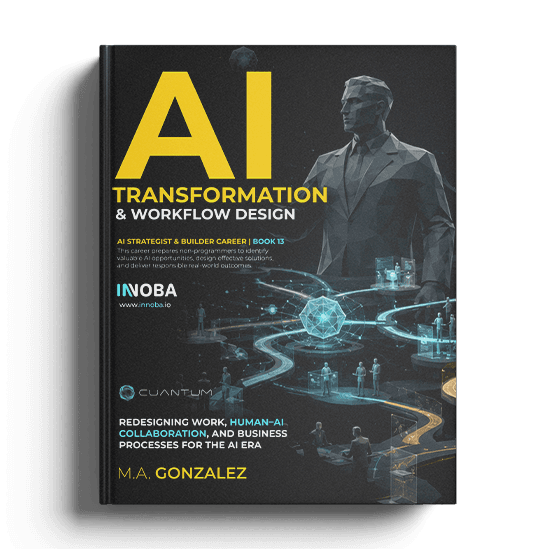
336 pages | 5 parts | 16 chapters
Extend workflow architecture into end-to-end redesign, human-AI role allocation, adoption, and organizational transformation.
Explore the BookHow the Books connect
Systems thinking defines the whole. Responsible AI establishes safe and accountable boundaries. Automation creates the operational backbone. Agents add adaptable behavior. AI Transformation & Workflow Design asks how the complete flow of work should change. Together they create workflows that are intelligent because they are intentionally redesigned—not merely because they contain AI.
Who this Path is for
Automation specialists, operations professionals, consultants, product builders, managers, and anyone working with multi-step or cross-functional processes.
Professional applications
Career connection
This is AUTOMATE’s systems-level synthesis. It turns strategic and design insight into operational architecture and prepares LAUNCH for adoption and continuous improvement.
Explore the CareerYour transformation
You should be able to explain who or what acts at each stage, how context moves, where uncertainty enters, how governance and human oversight apply, how exceptions are handled, how adoption is supported, and how the system learns.
A clear progression from learning individual skills (books) to building complex abilities (learning paths and academies) and an entire career around them.
A group of books builds learning paths; a group of learning paths builds Academies; and a group of Academies builds the AI Strategist & Builder Career.
Learn a specific skill or topic
Achieve a specific goal
Master a specialty
Become an AI Strategist & Builder
43¢day